
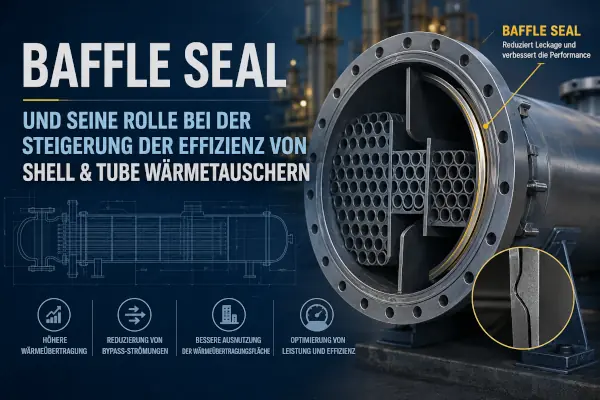
What is a Baffle Seal and what role does it play in improving the efficiency of Shell & Tube Heat Exchangers?
In Shell & Tube Heat Exchangers, the primary design objective is to maximize the heat transfer rate while minimizing energy losses and ensuring optimal utilization of the heat transfer surface. However, in the actual operation of these units, a portion of the shell-side fluid inevitably flows through non-effective paths and does not actively contribute to the heat transfer process.
One of the most significant of these paths is the clearance between the baffle edges and the inner wall of the shell, which leads to a phenomenon known as shell-side bypass flow or shell-side leakage. This bypass flow can create a considerable deviation between the design performance and the actual performance of the exchanger and, in many cases, results in a noticeable reduction in thermal efficiency.
In heat exchanger design and rating methods, such as TEMA-based approaches and simulation software like HTRI, leakage and bypass flows on the shell side are considered critical factors contributing to performance degradation. One of the most common leakage paths is baffle-to-shell leakage, which refers to the passage of a portion of the fluid through the gap between the baffle outer edge and the shell inner wall without effectively flowing through the tube bundle.
What is a Baffle Seal?
A Baffle Seal is a flexible metallic sealing element installed along the edges of baffles to reduce or nearly eliminate the clearance between the baffle and the inner wall of the shell.
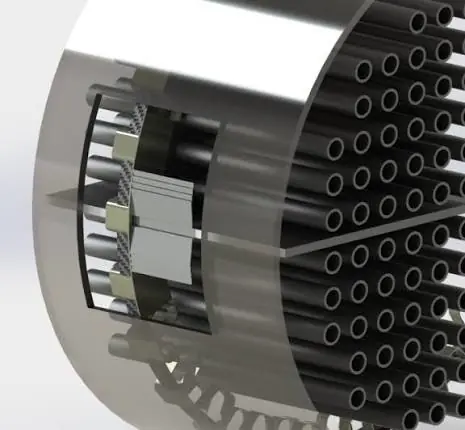
These seals are typically designed in leaf-type or strip-type metallic configurations, providing sufficient flexibility for installation while significantly reducing the effective clearance between the baffle and the shell during operation.
In standard heat exchanger design, a controlled clearance is intentionally provided between the baffle outer diameter and the shell inner diameter in order to:
- Facilitate tube bundle assembly
- Allow smooth insertion and removal of the tube bundle without mechanical interference or jamming
- Enable maintenance, inspection, and bundle withdrawal during shutdown periods
Although this clearance is necessary from a fabrication and maintenance standpoint, during operation it becomes a low-resistance flow path. As a result, a portion of the fluid bypasses the tube bundle, flows around the baffles, and exits the exchanger without participating effectively in heat transfer.
A Baffle Seal reduces or blocks this clearance and forces the shell-side flow to follow the intended path, namely cross flow through the tube bundle. This improved flow distribution increases fluid contact with the tube surface and enhances overall heat transfer efficiency.
Role of Baffle Seal in Improving Heat Transfer
In Shell & Tube Heat Exchangers, the highest heat transfer performance is achieved when the shell-side flow passes laterally across the tube bundle. This flow pattern increases turbulence and enhances convective heat transfer.
In an ideal configuration, the shell-side flow is guided by the baffles in a zig-zag or cross-flow pattern through the tube bundle. This increases fluid contact with the outer tube surface and enhances local mixing intensity, leading to an increase in:
- Flow turbulence
- Convective heat transfer coefficient (h)
- Overall heat transfer coefficient (U)
However, in the presence of bypass flow, a portion of the fluid passes through the exchanger without sufficient contact with the tube surface. Under such conditions, turbulence intensity is reduced, and a significant portion of the heat transfer surface becomes effectively underutilized.
The use of a Baffle Seal produces several important effects on exchanger performance:
- Reduction in bypass flow fraction
- Reduction in baffle-to-shell leakage
- Increase in cross-flow contribution through the tube bundle
- More effective utilization of the heat transfer surface
- Improved agreement between actual and design performance
In many industrial applications, this relatively simple modification can significantly increase the thermal capacity of the exchanger without requiring additional heat transfer area or major geometric modifications.
Effect on Pressure Drop
Improving flow distribution by reducing or eliminating bypass paths enhances thermal performance, but it also has a direct hydraulic impact.
With reduced bypass flow:
- The flow path becomes more constrained
- A larger fraction of the flow is forced through the tube bundle
- Average velocity within the tube region increases
- Consequently, shell-side pressure drop increases
Therefore, the design or retrofit of Baffle Seals always involves a trade-off between improved thermal performance and increased pressure drop.
In simpler terms, while reducing bypass improves heat transfer, this improvement comes at the cost of higher flow resistance. If the pressure drop exceeds allowable limits, upstream or downstream equipment such as pumps may face operational constraints.
For this reason, industrial projects typically evaluate this issue using specialized heat exchanger design software such as HTRI or Aspen EDR / HTFS in order to determine the optimal operating point from both thermal and hydraulic perspectives.
Role in Preventing Process Issues
In some industrial applications, the challenge is not limited to thermal efficiency, but also includes flow path control and prevention of unintended mixing or fluid bypass.
Under such conditions, the presence of bypass or leakage paths can lead to operational problems, reduced product quality, or increased corrosion risk.
Boiler Condensers
In boiler condenser systems, bypass flow or improper flow distribution can increase the likelihood of corrosive contaminants accumulating in undesired regions. This may result in:
- Increased corrosion rates in equipment
- Contamination of the boiler feedwater system
- Reduced lifetime of downstream equipment
- Higher maintenance and repair costs
In such cases, improved flow control within the exchanger helps reduce operational risks and enhances system stability.
Chemical and Dyeing Industries
In chemical processes, and particularly in dyeing and sensitive formulation industries, even small amounts of unintended mixing, temperature variation, or flow through non-design paths can lead to serious issues, including:
- Color variation in the final product
- Changes in chemical or physical properties
- Reduced process uniformity
- Production of off-spec material
Therefore, precise control of flow distribution in heat exchangers and reduction of unwanted leakage paths plays an important role in maintaining process quality.
Materials Used for Baffle Seals
The selection of Baffle Seal material depends on operating conditions such as temperature, pressure, fluid characteristics, corrosivity, and mechanical requirements. These components must withstand both corrosion and thermo-mechanical stresses.
Since Baffle Seals are in direct contact with the shell-side fluid, improper material selection may result in corrosion, deformation, mechanical failure, or reduced service life.
Common materials include:
Stainless Steel 304 / 316
These stainless steels are suitable for general industrial applications and many process services. Grade 316, due to the presence of molybdenum, provides better corrosion resistance than 304 and is preferred in more aggressive environments.
Stainless Steel 316Ti
Grade 316Ti, due to titanium stabilization, offers improved resistance to sensitization and is suitable for higher-temperature applications or conditions where intergranular corrosion may occur.
Duplex Stainless Steel
Duplex stainless steels are suitable for corrosive environments requiring higher mechanical strength. These materials are widely used in certain chemical, marine, and oil and gas applications.
Nickel Alloys (Inconel, Monel)
Nickel-based alloys such as Inconel and Monel are used in highly corrosive services, high-temperature environments, or special conditions in oil, gas, petrochemical, and chemical industries.
Proper material selection has a direct impact on durability, operational stability, and service life of the Baffle Seal.
Application in Revamp and Debottlenecking Projects
One of the most important applications of Baffle Seals is in revamp projects of existing heat exchangers.
In many aging industrial units, degradation in thermal performance is not necessarily due to insufficient heat transfer area, but is often caused by increased leakage and bypass flow on the shell side.
Over time, factors such as corrosion, deformation of internal components, increased clearances, repeated repairs, or mechanical wear can increase leakage paths and reduce thermal performance. In such cases, the installation of Baffle Seals can significantly restore performance without requiring full replacement of the exchanger.
Key advantages include:
- Significantly lower cost compared to full exchanger replacement
- Installation during scheduled shutdown periods
- Reduced plant downtime
- Improved performance without major mechanical redesign
- Potential increase in operational capacity in certain services
Therefore, Baffle Seal implementation is a well-established solution in debottlenecking projects within the oil, gas, refining, and petrochemical industries.
Conclusion
A Baffle Seal is one of the simplest yet most effective solutions for improving Shell & Tube Heat Exchanger performance.
By reducing bypass flow and increasing cross-flow contribution, it enables:
- Higher heat transfer coefficients
- Improved utilization of the heat transfer surface
- Reduced deviation between design and actual performance
- Increased thermal capacity without geometric modifications in many cases
However, it should be noted that the use of Baffle Seals may increase shell-side pressure drop. Therefore, their implementation must be based on detailed thermal-hydraulic analysis during design, revamp, or optimization stages.
Ultimately, when the goal is to improve efficiency, reduce bypass flow, enhance existing exchanger performance, or execute revamp and debottlenecking projects, Baffle Seals represent a cost-effective, reliable, and widely used solution in Shell & Tube Heat Exchangers.