
Uranium Enrichment and the Engineering of Gas Centrifuges
A Scientific Overview of Uranium Isotopes and Their Separation Technologies
Part I
Scientific Fundamentals of Uranium Isotopes and Enrichment
1. Introduction
Uranium is one of the heaviest naturally occurring elements in the periodic table and plays a crucial role in nuclear physics, nuclear energy production, and geochemical studies. What makes uranium particularly important from a scientific and technological perspective is that natural uranium consists of several isotopes with significantly different nuclear properties. The two most important isotopes are Uranium‑238 (U‑238) and Uranium‑235 (U‑235). Natural uranium consists approximately of:
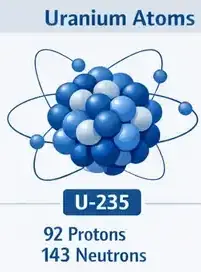
0.7% U‑235
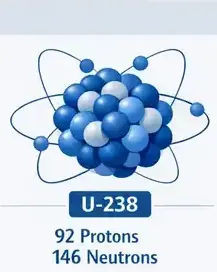
99.3% U‑238
trace amounts of U‑234 In many nuclear applications, particularly in power reactors, the concentration of U‑235 must be increased. The process of increasing the proportion of U‑235 relative to other isotopes is known as uranium enrichment. Understanding uranium enrichment requires familiarity with several fundamental concepts in nuclear physics, including isotopes, nuclear stability, nuclear fission, and isotope separation techniques.
2. The Concept of Isotopes
Isotopes are atoms of the same element that have: the same number of protons a different number of neutrons For uranium, the atomic number is 92, meaning that all uranium isotopes contain 92 protons. The difference lies in the number of neutrons. Thus: U‑235 contains 92 protons 143 neutrons while U‑238 contains 92 protons 146 neutrons. Since chemical behavior is determined primarily by the number of protons and the structure of the electron cloud, isotopes of the same element exhibit almost identical chemical properties. However, their nuclear properties can differ dramatically, because those depend on the internal structure of the nucleus.
3. Stability of Heavy Nuclei
Two main forces determine the stability of atomic nuclei: The strong nuclear force which provides an attractive interaction between nucleons (protons and neutrons), and The electrostatic Coulomb force which causes repulsion between positively charged protons. In lighter elements, the strong nuclear force easily overcomes the electrostatic repulsion. However, in very heavy nuclei such as uranium, the large number of protons creates strong repulsive forces. Neutrons play a stabilizing role because they contribute to the strong nuclear force without adding electrostatic repulsion. Therefore, the neutron‑to‑proton ratio becomes critical for nuclear stability.
4. The Fundamental Difference Between U‑235 and U‑238
Both uranium isotopes are radioactive, but their behavior when interacting with neutrons differs significantly. The key property of U‑235 is that it is fissile with thermal neutrons. When a slow neutron collides with a U‑235 nucleus, the following reaction occurs: U‑235 + n → U‑236* The resulting nucleus (U‑236) is formed in an excited state. This excited nucleus is unstable and rapidly splits into two smaller nuclei. This process produces: two fission fragments several free neutrons a large amount of energy This is the process known as nuclear fission.
5. Behavior of U‑238 Under Neutron Interaction
In contrast to U‑235, U‑238 does not normally undergo fission when struck by thermal neutrons. Instead, it typically captures the neutron: U‑238 + n → U‑239
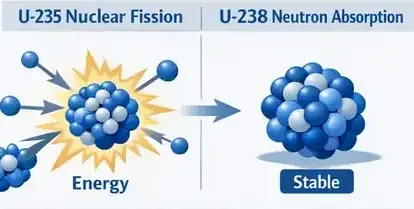
This unstable isotope then undergoes beta decay and eventually forms Plutonium‑239 (Pu‑239). Because of this property, U‑238 is often described as a fertile material, rather than a fissile material.
6. Why Enrichment Is Necessary
Natural uranium contains only about 0.7% U‑235. Most nuclear power reactors require uranium enriched to approximately: 3% – 5% U‑235 If the concentration of U‑235 is too low: most neutrons are absorbed by U‑238 the nuclear chain reaction cannot be sustained efficiently. Increasing the proportion of U‑235 raises the probability that neutrons will interact with fissile nuclei rather than being absorbed without producing fission.
7. Why Isotope Separation Is Difficult
The major challenge in uranium enrichment arises from the fact that U‑235 and U‑238 have nearly identical chemical properties. As a result: chemical separation methods are largely ineffective. The only significant difference between them is their atomic mass, which differs by only about three atomic mass units. When uranium is converted into the gaseous compound UF₆, the mass difference between the two molecular species is only about 1%. Therefore, enrichment technologies must rely on extremely sensitive physical processes capable of exploiting this very small mass difference.
8. Conversion of Uranium to Uranium Hexafluoride
Before isotope separation can occur, uranium must be converted into a gaseous form. The compound used for this purpose is uranium hexafluoride (UF₆). UF₆ has several useful properties: it becomes gaseous at about 56°C it is chemically stable enough for industrial processing it allows molecular separation techniques. In this gaseous form: UF₆ molecules containing U‑235 are slightly lighter UF₆ molecules containing U‑238 are slightly heavier All enrichment technologies exploit this small difference in molecular mass.
9. Main Enrichment Technologies
Three principal enrichment technologies have historically been used: Gaseous diffusion Gas centrifuge Laser isotope separation Gaseous diffusion was the earliest large‑scale enrichment technology but required enormous energy consumption. Today, almost all modern enrichment facilities use the gas centrifuge method, which is far more energy efficient. This method relies on centrifugal force to separate molecules according to their mass.
Part II
Engineering Structure and Technical Challenges of Gas Centrifuges
1. Physical Principle of the Gas Centrifuge
A gas centrifuge is essentially a long, narrow cylindrical rotor that spins at extremely high speeds. The centrifugal force acting on a particle in the rotating system is given by: F = mω²r where: m = particle mass ω = angular velocity r = radial distance from the axis In this rotating field: heavier molecules migrate toward the outer wall lighter molecules concentrate closer to the axis. This produces a radial concentration gradient of isotopes.
2. Why Centrifuges Cannot Simply Be Made Larger
At first glance, it might seem that building larger centrifuges would increase separation efficiency. However, severe mechanical limitations prevent this. The most important limitation is rotational stress in the rotor wall. The hoop stress generated by rotation can be approximated as: σ ≈ ρω²r² where: ρ = material density ω = angular velocity r = rotor radius This relationship shows that stress increases with the square of the rotor radius. If the radius doubles, the stress increases by a factor of four. At extremely high rotational speeds, this stress can exceed the tensile strength of the material, causing catastrophic rotor failure. For this reason, centrifuges are typically designed to be: long narrow with small diameters rather than large and wide.
3. Moment of Inertia and Shaft Failure
Another critical engineering challenge arises from the moment of inertia of the rotor. For a cylindrical rotor: I = ½ m r² Increasing the rotor radius dramatically increases the moment of inertia. This becomes particularly problematic during: startup shutdown passage through critical rotational speeds. Large torsional stresses may develop in the shaft. In many centrifuge systems, inertial stresses dominate over frictional stresses. If the rotor dynamics are not properly designed, the system may experience: resonance vibrations shaft bending catastrophic mechanical failure.
4. Critical Speeds and Rotor Dynamics
Every rotating structure has critical speeds at which resonance occurs. At these speeds, the rotational frequency coincides with the natural vibration frequency of the structure. When resonance occurs: vibration amplitudes increase dramatically. High‑speed centrifuge rotors typically pass through several critical speeds during acceleration. To prevent failure, engineers must ensure: precise rotor balancing appropriate structural flexibility sufficient vibration damping. Rotor dynamics therefore plays a central role in centrifuge design.
5. Bearing Challenges at Extreme SpeedsCentrifuges operate at rotational speeds that may exceed tens of thousands of revolutions per minute. At such speeds, conventional mechanical bearings suffer from: rapid wear excessive heat generation mechanical degradation. To address this problem, advanced bearing technologies are used. These may include: magnetic bearings or gas bearings Both approaches minimize physical contact and significantly reduce friction.
6. Importance of Vacuum Operation
Gas centrifuges typically operate inside a vacuum chamber. If air were present: aerodynamic drag would be extremely large significant heating would occur energy losses would increase dramatically. Operating under vacuum conditions greatly reduces aerodynamic resistance and allows the rotor to reach very high rotational speeds.
7. Couplings and Rotor Segmentation
In many centrifuge designs, the rotor consists of multiple sections connected by flexible couplings. These couplings serve several purposes: transmitting torque accommodating slight misalignment reducing vibration transmission. If a coupling is too rigid, bending stresses may increase. If it is too flexible, dynamic stability may be compromised. Designing the optimal coupling is therefore a delicate engineering task.
8. Materials Used in Centrifuge Rotors
Rotor materials must satisfy several demanding requirements: extremely high tensile strength low density resistance to fatigue and creep. Materials commonly used include: specialized high‑strength steels aluminum alloys carbon fiber composites. Carbon fiber composites are particularly advantageous because they combine very high tensile strength with low density, allowing higher rotational speeds without structural failure.
9. Internal Gas Flow Dynamics
Inside the rotating rotor, the UF₆ gas experiences complex flow patterns influenced by: centrifugal forces temperature gradients axial circulation. The internal structure of the centrifuge includes components such as: gas extraction scoops flow baffles axial circulation control systems. These elements are carefully designed to enhance isotope separation efficiency.
10. Centrifuge Cascades
A single centrifuge produces only a very small degree of separation. Therefore, hundreds or thousands of centrifuges are connected in a configuration known as a cascade. In such systems: partially enriched product moves to higher stages depleted material is recycled to earlier stages. Through successive stages, the concentration of U‑235 gradually increases.
Conclusion
Uranium enrichment relies on exploiting an extremely small physical difference between isotopes: a mass difference of only a few atomic units. Extracting useful separation from such a small difference requires extraordinarily sophisticated engineering. Gas centrifuges represent one of the most advanced applications of high‑speed rotating machinery. Their design involves a combination of disciplines including: nuclear physics fluid dynamics materials science structural mechanics rotor dynamics vibration engineering. The technical challenges—rotational stress, inertial forces, critical speeds, bearing limitations, and internal flow control—make centrifuge engineering one of the most demanding fields in modern mechanical and nuclear engineering.